

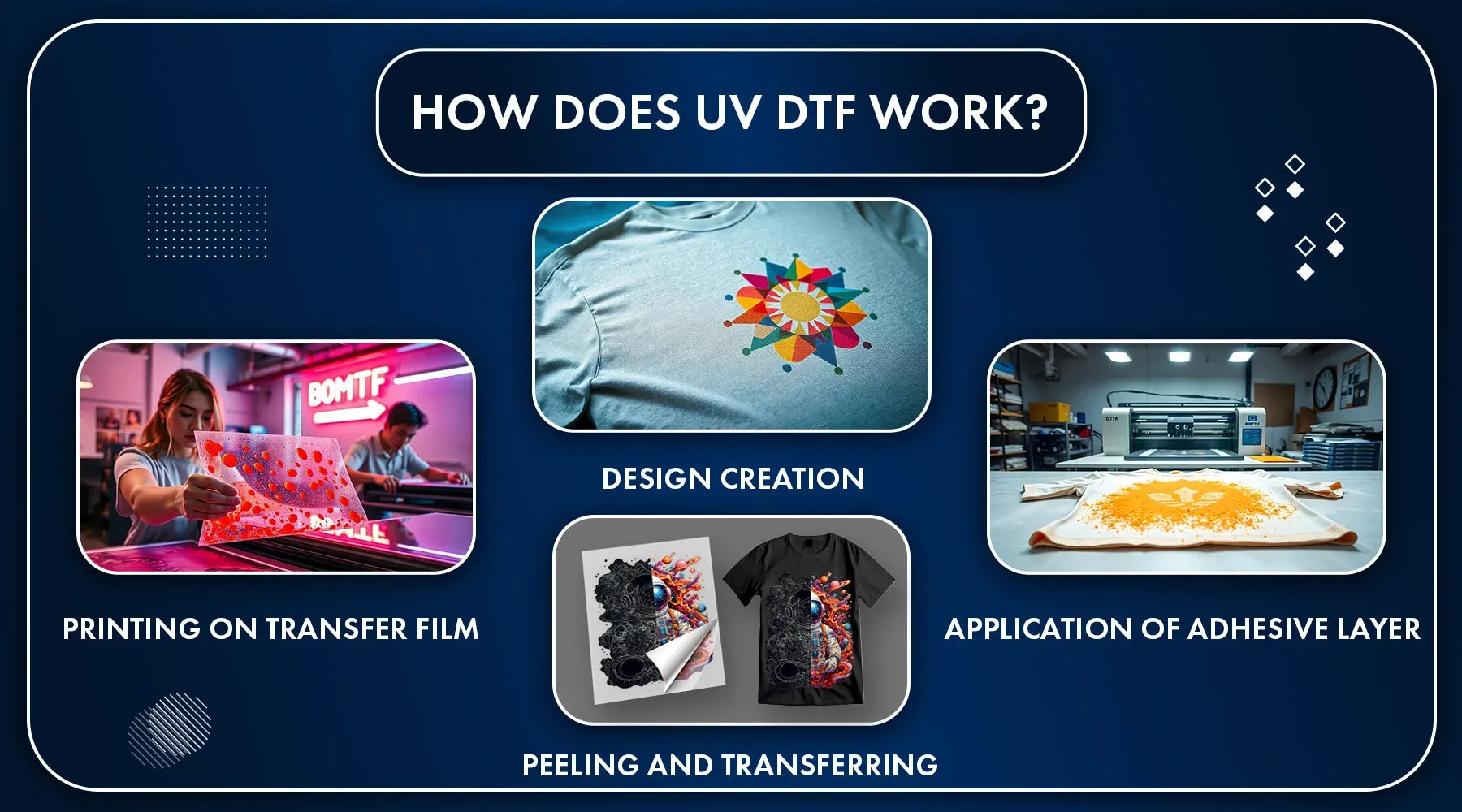
UV DTF transfer is transforming how small businesses print vibrant, durable designs on apparel and merchandise. This method blends UV-curable inks with traditional transfer workflows to speed up production and expand substrate compatibility. Understanding UV DTF transfer cost, DTF transfer setup, and UV printer ROI helps owners choose the right balance between upfront investments and per-unit profitability. With clear advantages in color fidelity and flexibility, UV DTF transfers are gaining popularity among creators who value fast turnarounds. Exploring related DTF options and DTF printing for small businesses, while evaluating UV printer ROI, will sharpen your decision.
If you prefer alternative terminology, this approach can be described as a UV-curable transfer technique that prints on a removable film before heat-pressing onto fabric. It’s also known as transfer-on-film technology or print-on-film transfer, delivering high detail and broad substrate compatibility. From a cost and planning perspective, consider the UV DTF transfer cost alongside ongoing maintenance and the potential uplift in UV printer ROI when volumes scale. For small businesses evaluating suppliers, a solid DTF transfer setup, balanced with color management and efficient workflow, minimizes risk and accelerates growth.
UV DTF transfer: Costs, Setup, and ROI for Small Biz
UV DTF transfer costs extend beyond the sticker price of hardware. For a typical small shop, it’s useful to separate upfront capital from ongoing operating costs: the UV printer, curing systems, transfer film, powders, inks, maintenance, ventilation, and software licenses. Understanding the UV DTF transfer cost helps you forecast the total cost of ownership and plan whether to buy, lease, or consider a used system. While the base guide notes that upfront investment can be higher than simpler transfers, it can pay off as throughput increases and per-unit costs fall with scale.
ROI for UV DTF transfer hinges on selling price, volume, and efficiency. A simplified example shows that with 150 shirts per month at $25 and variable costs of $12, plus $1,000 monthly overhead, net profit may be around $950. If the upfront system runs at about $60,000, the monthly ROI would be roughly 1.6%, or about 19% annually, given the same mix. In practice, ROI climbs with higher-margin products, automated workflows, and tighter waste control. Focus on throughput, setup time, and quality to improve the ROI over time and to shorten the time to value.
DTF transfer setup best practices for small business shops
DTF transfer setup best practices for small business shops begin with a clear product strategy. Define core items, typical run sizes, and target lead times, then tailor the printer configuration (width, resolution, color gamut) and curing approach. Many operators refer to DTF transfer setup as the act of configuring printers, media, and software for repeatable results with minimal waste, so start by documenting a repeatable process before you scale.
Next, align media, inks, and RIP workflows with a standardized pre-press and press routine. Establish a color management plan, calibration targets, and a simple QA checklist to ensure consistency across orders. Layout a practical production flow that minimizes handling, guards safety, and maintains adequate ventilation. A strong setup also includes pilot proofs and swatches to quickly validate color and finish before committing to full runs.
DTF printing for small businesses: choosing the right UV DTF transfer options
DTF printing for small businesses often hinges on choosing the right UV DTF transfer options for your product mix and customer expectations. Evaluate design complexity, substrate variety, and storage needs. Explore DTF options such as transfer films, powders, and adhesive formulations to match fabrics, plastics, and blends, while considering how prints can be stored prior to pressing.
DTF printing for small businesses also implies testing different options and refining your workflow. Start with a small pilot, measure adhesion, color fidelity, and wash durability, and collect feedback from customers. The right combination of film type, ink chemistry, heat-press parameters, and post-press finishing will influence hand feel, flexibility, and durability; as you compare options, you’ll better serve your market and reduce returns. For many teams, this approach is central to a scalable, design-forward operation.
UV printer ROI and cost considerations in DTF workflows
UV printer ROI and cost considerations in DTF workflows require a disciplined look at per-unit economics and depreciation. Track the true cost of ownership, including energy, maintenance, and software, along with the incremental revenue that UV DTF transfer enables. A practical lens is to compare the UV printer ROI across scenarios: different volumes, different product mixes, and varying automation levels. When you model multiple cases, you’ll see how scaling output or improving yield impacts profitability more dramatically than the headline equipment price.
Beyond the numbers, align the business case with your sales strategy. High-value designs, faster turnaround, and the ability to offer limited editions can lift margins and shorten payback. Use pilots to quantify improvements in speed and waste reduction, then monitor ongoing costs such as consumable usage and replacement parts. In the end, the ROI of UV DTF transfer depends on disciplined cost control, demand forecasting, and continuous workflow optimization.
DTF transfer cost per unit: materials, labor, and overhead management
DTF transfer cost per unit is a useful lens for pricing and profitability. Break costs into materials (transfer film, inks, powders if used), labor (pre-press, print, cure, transfer, press), and overhead (utilities, software, depreciation). The per-unit calculation helps you set realistic price points and understand where improvements will have the biggest impact. Keeping a running tally of consumable usage and scrap rates also helps you identify waste and drive down the DTF transfer cost over time.
To hit target margins, consider strategies like batch printing, standardizing press temperatures and times, and negotiating film or ink bulk discounts with suppliers. This approach makes it easier to maintain consistent quality while controlling costs as volume grows. A structured cost-per-unit model supports better pricing decisions and can reveal when it’s time to upgrade equipment or adjust the product mix to protect margins.
DTF options and technology comparison: UV DTF transfer vs DTG, screen printing, and standard DTF
DTF options and technology comparison: UV DTF transfer vs DTG, screen printing, and standard DTF involves weighing capabilities against needs. The range of DTF options includes different transfer films, powders, curing methods, and ink chemistries, each with implications for substrate compatibility, hand feel, and durability. For some shops, UV DTF transfer offers fast cure times and strong color fidelity, while others may favor traditional DTF or DTG for specific fabrics or volumes.
Choosing the right path means matching capabilities to demand. Use test runs to compare print quality, wash durability, and production speed across methods. For small-batch or high-detail jobs, UV DTF transfer can deliver vibrant results, but for large runs or very soft hand feels, screen printing or DTG might be preferable. Understanding your product mix, customer expectations, and cost structure will help you select among the available options and build a multi-technology workflow that scales with your business.
Frequently Asked Questions
What is UV DTF transfer and how does the UV DTF transfer cost affect profitability for a small business?
UV DTF transfer prints with UV-curable inks on a transfer film, then transfers to fabric or other substrates. UV DTF transfer cost includes upfront equipment, transfer film, inks, powders (if used), maintenance, and curing hardware. While upfront costs can be high, per-unit costs drop with volume. To improve profitability, optimize material use, automate steps where possible, and run pilots to quantify ROI.
What does a typical DTF transfer setup look like for UV DTF transfer workflows?
A typical DTF transfer setup for UV DTF transfer includes selecting a UV printer with suitable width and curing options, stocking compatible transfer film and powders, installing RIP software and color management profiles, calibrating curing times and heat-press settings, and establishing a standardized workflow to minimize waste and handling time.
What UV printer ROI can you expect when using UV DTF transfer?
With a UV printer used for UV DTF transfer, you evaluate profitability using the UV printer ROI concept: compare monthly net profit from UV DTF transfers to the upfront investment in the printer and curing setup. ROI = (Net Profit per month / Upfront Investment) x 100. Track revenue, variable costs, and overhead, run a short pilot, and scale when ROI improves.
Why is UV DTF transfer a good option for DTF printing for small businesses?
UV DTF transfer is a compelling option for DTF printing for small businesses because it delivers vibrant, durable designs with fast turnaround, which fits small runs and customization. Consider substrate compatibility, cost per unit, and ongoing maintenance, and compare UV DTF with DTG or screen printing to choose the best fit for your product mix.
What DTF options should I consider when implementing UV DTF transfer?
DTF options to evaluate include transfer film types (coated vs. non-coated), powders, UV inks, printer configurations, curing methods, and RIP color management. Consider substrate compatibility, color vibrancy, and cost per unit, then test multiple DTF options to optimize performance and ROI.
How do UV DTF transfer costs break down, including upfront DTF transfer cost and ongoing expenses, and how does that affect ROI?
UV DTF transfer costs break down into upfront costs (UV printer, curing hardware, software, initial stock) and ongoing costs (film, inks, powders, maintenance, utilities). Per-unit costs depend on material and labor, plus overhead. To estimate ROI, use ROI = (Net Profit per month / Total Investment) x 100 and adjust pricing, workflow, and volume to improve profitability.
| Topic | Key Points |
|---|---|
| What is UV DTF transfer? |
|
| Why small biz consider UV DTF |
|
| Cost considerations |
|
| DTF transfer setup basics |
|
| ROI framework and example |
|
| Practical considerations |
|
| UV DTF vs other methods |
|
| Implementation steps |
|
Summary
UV DTF transfer can be a powerful addition to a small business’s print shop, offering vivid, durable results and the flexibility to fulfill a range of orders. This approach blends UV-curable printing with a traditional transfer workflow, enabling clearer cost visibility, setup considerations, and ROI evaluation. For small businesses, key factors include upfront equipment investments, ongoing consumables, color management, and a repeatable workflow that minimizes waste and handling time. ROI is driven by product mix, margins, automation, and scale, with higher-margin designs and efficient production yielding stronger returns. Practical steps to implement include defining products, selecting compatible equipment and media, building a standardized workflow, piloting the process, and marketing the capability as a differentiator. With careful planning and ongoing optimization, UV DTF transfer can deliver competitive advantages and a path to sustainable growth.